An examination of the role of push hands in the development and expression of Taiji skill.
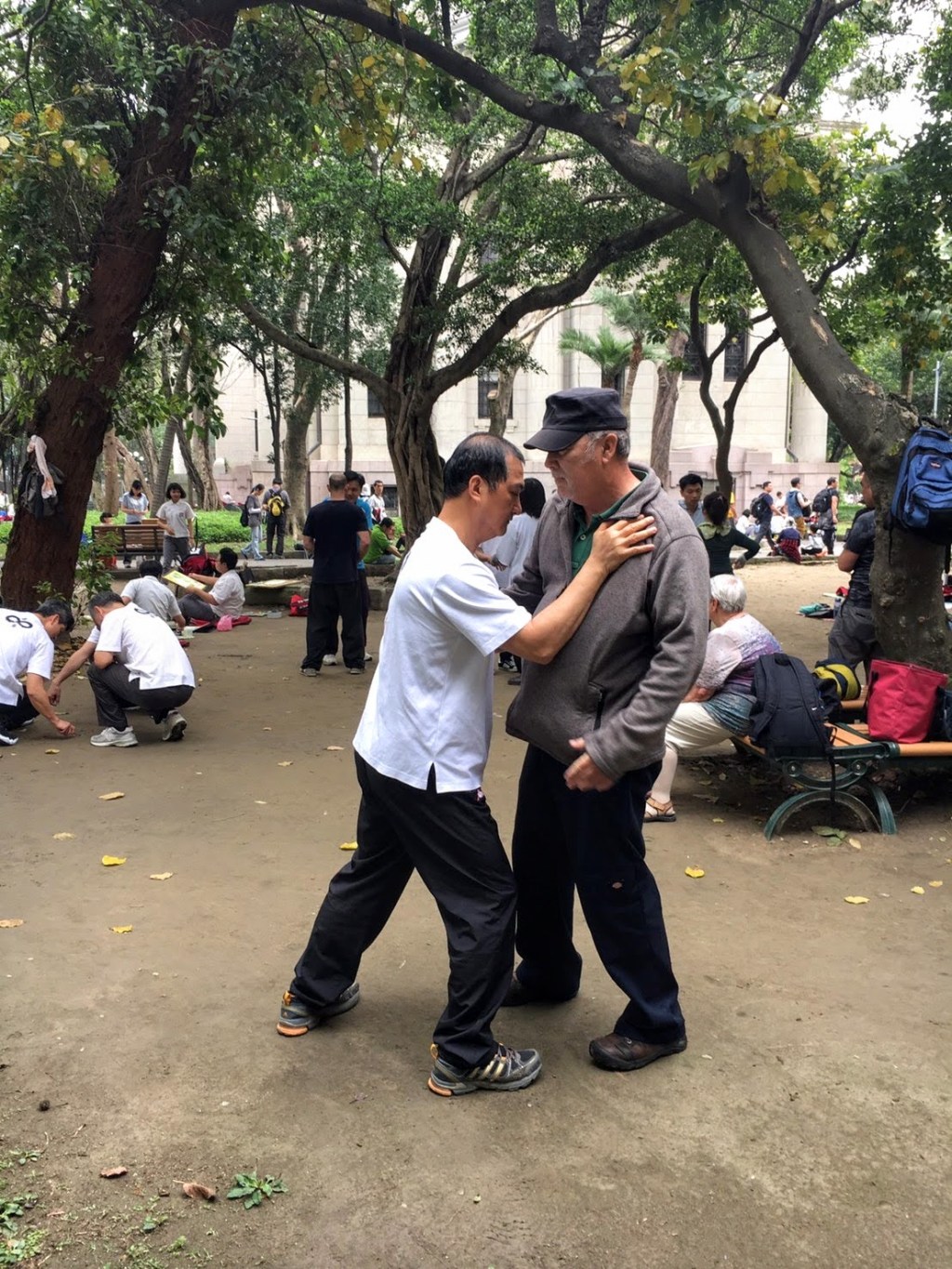
Push hands (推手) has long been part of traditional Taiji training. Today its practice ranges from cooperative exercises to competitive events. Although these activities share a name, their objectives may differ considerably.
The Original Intention
Within traditional Taiji practice, push hands provides a means through which certain qualities being developed in solo practice may be explored through contact with another person.
- 聽勁 — Tīng jìn, listening skill.
- 懂勁 — Dǒng jìn, understanding jin.
- 粘黏連隨 — Adhering, sticking, connecting and following.
- 不丟不頂 — Neither losing contact nor directly resisting.
- 用意不用力 — Using intent rather than force.
These principles are not exclusive to push hands, nor is their expression necessarily limited to physical contact.
Wang Yongquan (汪永泉, 1904–1987), in his writings on Yang-style Taiji, addressed the purpose of push hands quite directly. He preferred the term roushou (揉手), or rubbing hands, to distinguish the practice from what push hands had become, emphasizing its original purpose and the development of genuine Taiji skill.
Practicing Roushou Must Have a Correct Purpose
揉手要有正确的目的
Wang writes:
The purpose of practicing roushou is to correct the practitioner’s misunderstanding of Taiji theory, to discover and correct improper methods of practicing the form and roushou itself, and to avoid deviations that may lead one’s practice in the wrong direction.
He further observes that some practitioners mistakenly regard roushou as a means of determining who is superior. Such an understanding may lead to misunderstandings, friction between practitioners, and even physical injury. He cautions against introducing non-Taiji methods of hand fighting, free fighting, and joint manipulation into the exercise, thereby turning roushou into a contest of strength.
The primary purpose of practicing roushou is to develop dong jin (understanding jin) and to acquire genuine Taiji skill, rather than to contend for superiority and victory by whatever means necessary.
练习揉手主要是为了“懂劲儿”,为了练成真正的太极功夫,而不是为了争强好胜,以致不择手段。
Wang also recalls the words of his teacher, Yang Chengfu:
When practicing roushou, one must prevail through the skill of Taiji itself. Only then will the other person be convinced in both words and heart.
Martial Ethics and the Attitude Toward Practice
In the preceding sections, Wang emphasizes martial ethics (武德): cultivating moral character, transforming one’s fiery temperament, softening acquired physical strength, removing arrogance, and relinquishing the desire to fight. These matters should be addressed before transmitting the art and reinforced throughout training.
He encourages practitioners to learn humbly from seniors, contemporaries and juniors who have made correct progress. He also cautions against selectively extracting passages from the classics to support one’s existing ideas, warning that blindly pursuing such interpretations may hinder development or cause injury.
The Relationship Between Form and Push Hands
If the qualities being developed through form practice are not reflected when one comes into contact with another person, what then is the relationship between the two methods of training?
When I first observed my teacher, Zhang Yongliang, my impression was that he had modified his movements to accommodate the conditions under which he demonstrated his practice, most often through push hands. Over time, my understanding of what I was observing changed.
His practice appeared to have developed to the point where the larger movements were no longer necessary. What was expressed during push hands was also evident when people engaged with him outside that format. There was no apparent need to adopt a different method of movement.
When my teacher encountered others who were interested in his practice and wished to test his abilities, they would often ask how he wanted them to attack him. His response, always accompanied by a smile, was the same: “Do what you want.”
He already in his eighties at the time. The results were invariably the same. When they attacked unexpectedly, he would, with a smile, either be somewhere else or, while remaining still, give them no place to find him.
In my own practice, I have sought to develop through the form qualities that remain present regardless of how another person engages with me.
Within and Outside One’s Training Group
Within one’s own training group, there is generally a shared understanding of what is being developed. Outside the group, practitioners may bring different methods, interpretations and objectives.
Such encounters provide an opportunity to learn about one’s own abilities. Unless there is a shared interest in exploring a particular practice, I would distinguish this from attempting to learn another’s methods or impose one’s own.
Northern California — August 9, 2014
I was invited to assist with demonstrations at a push hands workshop held during the twelfth annual Chinese American Olympics of Northern California (北加州華人體育). As it happened, I was the only person there who did not speak Chinese.
The workshop brought together practitioners from different backgrounds. The accompanying footage is a record of my practice at that time.
The 2014 excerpt is taken from this workshop. View the original workshop footage on YouTube.
Looking back, I can see aspects of my practice that have remained and others that have changed. What was once considered an accomplishment may later be recognized as an intermediate stage.
The Emergence of Competitive Push Hands
Competitive push hands developed in part through efforts to promote Taiji and broaden participation. With rules, scoring and weight divisions, training naturally begins to reflect the conditions under which success is measured.
At a competition I attended in the 1990s, push hands was opened to participants from outside the Taiji community. Despite their different training methods, they competed successfully within the established rules.
The objective of competition is to win within its rules. Whether the skills employed reflect the principles of Taiji is another matter. As Yang Chengfu’s words suggest, the distinction is not simply whether one prevails, but whether one does so through Taiji skill.
Training for competition and using push hands to develop Taiji need not be mutually exclusive, but neither should we assume they lead to the same result.
Beyond the Push Hands Format
As distance, movement and the nature of contact change, one may discover whether the qualities developed through push hands remain present. In my own practice, this has led toward a freer exploration of the principles underlying the exercise.
The exercise provides a means of development, but need not define the limits of what is developed.
Closing Reflections
Perhaps the question is whether one is developing the ability to do push hands or using push hands to develop one’s Taiji.
Reference
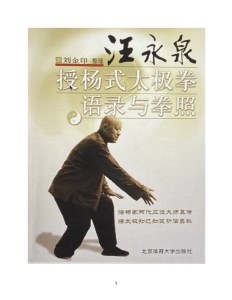
汪永泉授杨式太极拳语录与拳照
Wang Yongquan’s Teachings on Yang-Style Taijiquan: Recorded Sayings and Photographs. Compiled by Liu Jinyin (刘金印). Beijing Sport University Press (北京体育大学出版社).
Translated excerpts from sections (三) 教拳先教武德, (四) 虚心向前辈、同辈、晚辈请教, and (五) 揉手要有正确的目的. English translations from the supplied Chinese text.

