
Based on the teachings of Wang Yongquan and the practice of Zhang Yongliang
Overview
Taiji is spherical in character. The practice of Taijiquan cultivates a body that embodies spherical qualities — not as a perfect geometric sphere, but as a body organized around a vertical axis, with qi fields (气圈) radiating outward and intention (意) unifying both real and virtual lines of connection.
Wei Shuren describes in his book
“杨式太极拳术述真” A True Account of Yang Style Tai Chi Chuan”
Three primary qi fields:
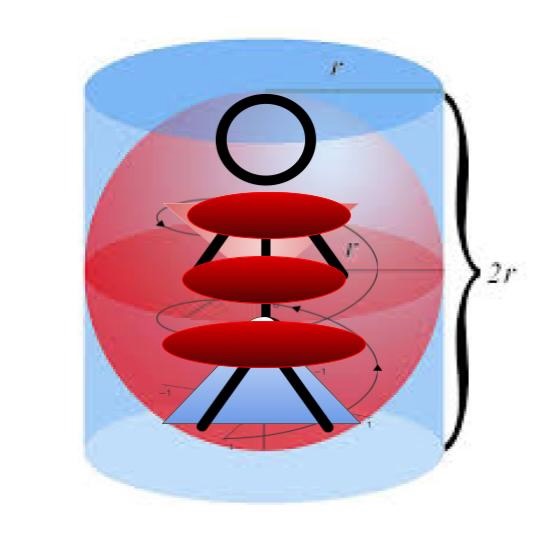
- Hip qi field (胯圈) — approximately 1 meter in diameter
- Waist qi field (腰圈) — approximately 80 centimeters in diameter
- Shoulder qi field (肩圈) — approximately 1 meter in diameter
These fields are not fixed. Through relaxation (松), dispersion (散), circulation (通), and emptiness (空), they expand, contract, and transform. They consist of both real and virtual aspects — the physical structure of the body and the intention that organizes and connects it.
The Spherical Body
A sphere is formed by a radius rotating around a central axis terminating at two poles. In Taijiquan, this principle may be understood through the body’s vertical central line (身中垂直线), defined by three primary alignments:
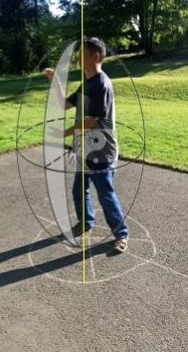
- Baihui (百会) — crown of the head, suspended upward
- Weilü (尾闾) — tailbone, acting as the central pivot
- Yongquan (涌泉) — bubbling well points, rooting downward through the feet
When these points are aligned and connected, the body develops spherical characteristics — not as a literal sphere, but as a body capable of expanding, rotating, and connecting in all directions around a central axis.
The qi fields radiate outward from this axis. The lines between points, whether physical or imagined, are unified through intention (意).
The sphere itself is made of the real and the virtual — the physical structure and the intention that organizes it. It is better understood as a spherical body: a body organized and functioning according to spherical principles.
Inner Circle and Outer Circle
The inner sphere is defined by the body’s natural structure, particularly the relationship between the shoulders, waist, hips, and central axis. This forms the minimum sphere present at rest.
Outer Circle
The outer sphere expands beyond the body through intention and internal organization. As practice deepens, the qi fields enlarge while remaining unified through the central axis.
Wei Shuren writes:
“Relax, disperse, circulate, empty” (松散通空)
Dispersion (散) allows intention and qi to extend outward through the body. Without relaxation, dispersion cannot occur; without dispersion, the fields collapse inward.
The Cylinder and the Vertical Axis
The cylinder describes power generation from a vertical axis — rotation, spiraling, and whole-body connection. It is not meant as a rigid geometric constraint, but as a way of understanding how force is organized through the body’s vertical axis.
The limbs move through arcs consistent with spherical movement, while force generation and transmission occur through spiraling rotation around the vertical axis.
Power is not transmitted from the ground.
The ground provides structural integrity and rooting, but the power is already present in the body—organized by intention (yi), supported by qi, and released when the connection to the opponent breaks or opens. The legs and kua do not “send” power upward. They maintain the spherical structure that allows release to occur instantly and without local effort.
Wei Shuren writes:
“The waist circle serves as the rear support for the elbows. The movement of the elbows can never be separated from the support and assistance of the waist circle.”
The waist circle acts as a central rotational layer linking upper and lower body. The arms and legs do not move independently, but follow the organization of the center.
Equilibrium and the Qi Fields
Taijiquan continuously shifts between:
- stable equilibrium,
- neutral equilibrium,
- and unstable equilibrium.
The goal is not rigidity, but the maintenance of central equilibrium (立身中正) while the qi fields rotate, expand, contract, and transform.
Wei Shuren writes:
“The vertical central line in the body is a line of awareness. It hangs straight down from below the neck to a point between the two feet. All movements rely on the shifting of this vertical central line to determine the placement of the body’s center of gravity.”
The qi fields rotate around this vertical axis. Their movement creates whole-body force through the combination of:
- rotation,
- translation,
- spiraling continuity,
- and coordinated change.
Wei Shuren describes this as the mutual transformation of cardinal and corner forces (正隅相化).
The Hollow Spherical Body
An advanced stage of practice is described as complete bodily emptiness and transparency (全体透空).
Wei Shuren writes:
“The hands dance without knowing they are dancing, the feet step without knowing they are stepping. Leisurely and naturally, one enters the realm of no-self, no-doing, the state of the entire body being transparently empty.”
In this state, the body functions as a hollow spherical structure:
- empty at the center,
- organized around the vertical axis,
- and unified through the qi fields.
Movement no longer feels isolated to individual muscles or local actions. Instead, movement emerges through the organization of the whole body.
Wei Shuren writes:
“If you can truly rely on the large energy sphere in front of your chest, your hands will no longer exert force to push or shove the opponent, nor will they receive the opponent’s incoming force. Even though your hands are in contact with the opponent, in your intention it will feel as if both hands are adhering to the large energy sphere in front of your chest.”
These models may help describe relationships observed through training:
- center organization,
- rotational movement,
- equilibrium,
- intention,
- spatial awareness,
- and whole-body integration.
Ultimately, Taiji remains experiential. The concepts must be verified through practice, not merely understood intellectually.
first experience, then understanding.
:


