

Many questions in todays time as to why people react as they do in demos of past and present masters or practitioners working with this theory.
Wang Yongquan, a prominent Yang-style Taijiquan master, learned from Yang Jianhou, Yang Chengfu, and Yang Shaohou. Over decades, he developed profound Taiji skills, blending tradition with innovation. His unique style, referred to as “Wang’s Transmission” (汪传), emphasizes the principle of “using one’s center to strike the opponent’s center” (以中碰中) through internal energy (神、意、气).
Key Concepts in Wang’s Taiji Approach
“Center” (中) and Strike Points
The “center” is a precise internal target that controls the opponent’s entire body.
Effective strikes can generate a “four-ounce moves a thousand pounds” effect.
“Balloon Energy” (气球功夫)
A core aspect of Wang’s internal technique is “balloon energy”, a method of soft, expansive, and spherical energy circulation that enhances both self-cultivation and combat.
Wang describes the body as filled with interconnected “energy balloons” that expand and contract dynamically.
Unique Taiji Techniques
Listening, Asking, Controlling, Releasing (听、问、拿、放): Understanding and manipulating the opponent’s force.
Indirect Contact: Striking the opponent’s center through an “energy balloon” rather than direct impact.
High-Level Reflexive Combat: At the advanced stage, Wang could automatically counter opponents without consciously aiming, similar to a table tennis player’s reflexive movements.
Wang’s Transmission has many characteristics across various levels. However, the most distinctive feature is the concept of “using ‘center’ to strike ‘center’”—this article briefly explores this concept.
Wang Yongquan: Using “Center” to Strike “Center”
Taijiquan is a profound and vast part of traditional Chinese culture. Master Wang Yongquan studied Taijiquan under his father in childhood, learning from Yang Jianhou. He later became a disciple of Yang Chengfu and frequently received guidance from Yang Shaohou, inheriting authentic teachings from three great masters across two generations. After decades of practice, Wang achieved an advanced level of Taiji skill, both preserving tradition and innovating, making significant contributions to the transmission and development of Yang-style Taijiquan. Wang’s transmission of Yang-style Taijiquan (henceforth referred to as “Wang’s Transmission”) has unique characteristics, leaving behind a valuable legacy that deserves exploration, preservation, and promotion.
Master Wang once said:
“When learning a martial art from a teacher, one must first understand its characteristics. Grasping these key features allows for faster and better learning.”
Wang was known for his exceptional Taiji skills. Regardless of his opponent’s size, stance, hand position, or attacking force, as soon as he made contact, his opponent would be effortlessly bounced away. This phenomenon was often described as having “spring-like force throughout the body, expanding and contracting with precise timing.” The opponent would feel as if they were “a coin hitting a drum” or “a ball bouncing off a wall.” Notably, those struck did not feel pain but sometimes even felt a sense of comfort. His techniques did not involve forceful clashes, wrestling, or brute pushing but instead relied on refined internal energy.
Some examples of his skill include:
- A young man, refusing to queue properly, swung a carrying pole at Wang. Upon contact, Wang sent him flying two meters away.
- While dining at a restaurant, Wang declined to buy peanuts from an aggressive street vendor. The vendor attacked, but Wang immediately rebounded him two tables away.
- Sitting in a chair with his arms bent in front of his chest, Wang gently moved his wrists, sending a listening-energy practitioner flying two to three meters.
- In another instance, a visitor assumed a horse stance in front of Wang, who lightly flicked his upper arm with two fingers, causing him to jump sideways two steps—demonstrating Yang Shaohou’s two-finger striking technique.
The Core Concept: “Using ‘Center’ to Strike ‘Center’”
Wang’s extraordinary skill stems from his mastery of various internal power principles, which he summarized as “using ‘center’ to strike ‘center.’” This means striking the opponent’s center with one’s own spiritual, intentional, and energetic center. However, this is not a direct impact; rather, it is done through the concept of an energy sphere (气球 qìqiú).
Two key components define this approach:
- The “Center” (中 zhōng) – The final focal point where spirit (神 shén), intent (意 yì), and energy (气 qì) converge to strike.
- The Energy Sphere (气球 qìqiú) – The method through which energy is transmitted, different from conventional external force techniques.
The Meaning of “Center” in Wang’s Taijiquan
In Taiji, “center” refers to a specific point in the opponent’s body that serves as an ideal striking target. While some martial arts target tight or tense areas, Wang’s approach treats the opponent as a whole, striking a single precise point to affect their entire body, achieving the principle of “using four ounces to move a thousand pounds.”
The “center” is a specialized term derived from “center of gravity” (重心 zhòngxīn). However, Wang distinguishes between “center” (中) and “center of gravity” (重心)—a crucial concept in his method. The center is an internal energy focal point, while the center of gravity is an external, mechanical balance point. Mastery requires understanding both to apply force correctly.
Application of “Center” and the Energy Sphere
The opponent’s center is not fixed; it shifts based on their posture, hand position, structure, and energy flow. Thus, Wang taught that one should aim at a moving center within an energetic framework. The key is striking slightly off-center, hitting an upper or lower dead point (上死点 / 下死点).
Striking techniques include:
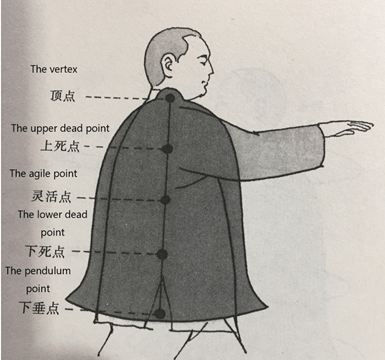
- “Fatal Point” (绝命点)
- “Upper Dead Point” (上死点)
- “Lower Dead Point” (下死点)
- “Dantian” (丹田)
- “Tailbone” (尾闾)
After striking, the force must flow beyond the opponent’s body, reaching an external point called the “drop point” (落点). Wang emphasized that the strike should be felt internally and not just as a superficial impact.
The Unique “Energy Sphere” Method
Wang’s concept of the energy sphere (气球 qìqiú) is central to his Taiji method. Unlike rigid force, it is a soft, diffuse, and round energy field. He described it as:
“Relaxed and dispersed energy forms an empty, light, and scattered energy sphere, which nourishes health and develops internal power.”
Every part of the body is considered an energy sphere:
- The entire body is a large sphere.
- Smaller spheres exist within the body, such as in the hands and feet.
- The size of the sphere varies with skill—advanced practitioners generate smaller, more concentrated spheres.
Characteristics of the energy sphere:
- It is soft, empty, and formless (空、虚、散).
- It lacks edges or boundaries and is invisible yet tangible.
- It is created through the relaxation and expansion of energy, not by physical tension.
The energy sphere expands in all three dimensions rather than just in a single plane. Wang used the analogy of a stone dropping into water, creating ripples that spread in multiple directions. Many mistakenly think energy flows in only one direction, but true internal power radiates omnidirectionally.
The Two Stages of Mastery
- Basic Stage – Learning to listen, adhere, control, and release, finding and striking the opponent’s center.
- Advanced Stage – Relaxing one’s energy to form an omnipresent energy sphere. Instead of seeking the opponent’s center, one lets them collide into the energy sphere and be rebounded effortlessly.
In the advanced stage, Wang’s ability became instinctive, like a table tennis player responding to a fastball without conscious thought. His refined techniques exemplified “automatic” Taiji reactions.
Conclusion
Wang Yongquan’s “Using ‘Center’ to Strike ‘Center’” principle represents a pinnacle of Taijiquan’s internal power methods. His energy sphere technique offers insights into both martial application and health cultivation. With dedicated practice, committed learners can achieve this high level, preserving and promoting the rich legacy of Taijiquan.

 empty circle taiji